

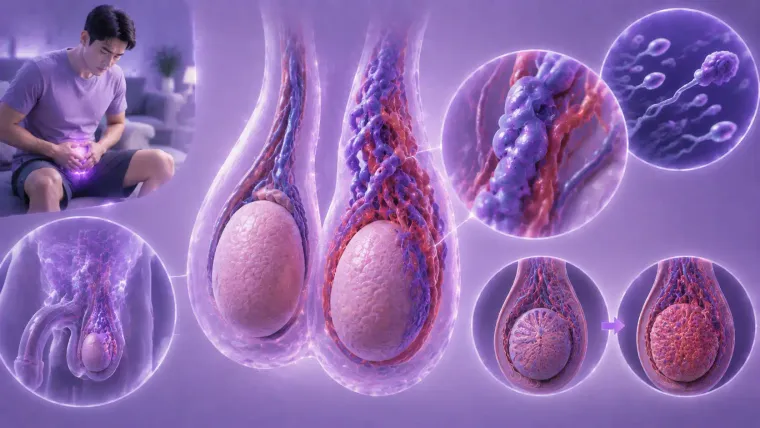
Varicocele is one of the most frequently diagnosed causes of male infertility. This condition is found in about 15% of adult men in the general population, but its prevalence jumps to 25–35% in men with primary infertility, and 50–80% in secondary infertility cases. Although it sounds alarming, varicocele is the most medically correctable cause of male infertility.
What is a Varicocele and How Does It Occur?
A varicocele is an abnormal enlargement of the veins within the scrotum, specifically in the pampiniform plexus — a network of veins that wraps around the spermatic cord and functions to keep the testicular temperature cooler than body temperature. This condition occurs due to the failure of venous valves — small structures inside the blood vessels that function to prevent blood from flowing backward, or an obstruction in the internal spermatic vein — the main vein that drains blood from the testicles back to the body, causing blood to pool and increasing hydrostatic pressure — the pressure exerted by stationary or slow-moving fluid within the blood vessels around the testicles.
Why Does Varicocele Damage Sperm?
The pathophysiology (the biological mechanism that explains how a disease damages body functions) of varicocele affects testicular function in several ways:
- Excessive Heat to the Testicles: The pooling of warm blood disrupts the testicles’ natural heat exchange system, increasing the local scrotal temperature — a condition called scrotal hyperthermia — which impairs the sperm formation process (spermatogenesis).
- Leydig Cell Damage: Increased venous pressure impairs the function of Leydig cells — specialized cells inside the testicles tasked with producing testosterone, leading to a decrease in intratesticular testosterone levels — the testosterone levels inside the testicular tissue itself required for sperm formation.
- Oxygen Deprivation and Sperm Cell Damage: Blocked blood flow causes hypoxia — a condition where the testicular tissue lacks oxygen, triggering a buildup of free radicals. This condition is called oxidative stress — a state where cell damage from free radicals exceeds the body’s natural protective capacity, which damages sperm DNA integrity.
The impact is seen in sperm analysis results, which often show a combination of oligozoospermia (sperm count is too low), asthenozoospermia (slow or inactive sperm movement), and teratozoospermia (sperm shape is mostly abnormal).
Clinical Symptoms and Varicocele Grade Classification
In most men, varicoceles are asymptomatic (causing no felt symptoms) and are only detected during a fertility evaluation. Some patients report a dull aching pain in the scrotal area that worsens with prolonged standing and subsides when lying down.
Varicoceles are classified based on physical examination:
- Grade I: Only detectable when the patient bears down using the Valsalva maneuver technique — a straining technique with a closed mouth and nose to increase pressure in the abdominal cavity, making problematic veins easier to palpate.
- Grade II: Easily palpable without the Valsalva maneuver, but not visually apparent.
- Grade III: Clearly visible to the naked eye, displaying a tortuous structure resembling a “bag of worms” on the scrotum.
To confirm the severity, doctors recommend a Scrotal Doppler Ultrasound — a specialized ultrasound examination that can detect the direction and speed of blood flow inside the scrotal veins. Based on European Association of Urology (EAU) guidelines, a varicocele is confirmed if the vein diameter exceeds 3 mm in a standing position accompanied by reflux (abnormal backward blood flow in the vein) for more than 2 seconds.
Treatment Options: Varicocelectomy and Embolization
Corrective action is recommended for patients who have a palpable varicocele, couples experiencing infertility with normal or treatable female factors, and those showing abnormal sperm analysis results.
1. Microsurgical Varicocelectomy
This is the current gold standard therapy for varicoceles. Using an operating microscope, the doctor performs ligation — precise tying off and cutting of the enlarged veins while preserving the testicular arteries and lymphatic vessels. This technique has the highest success rate of sperm improvement with the lowest risk of complications such as hydrocele (fluid buildup around the testicles) and recurrence (return of the same condition).
2. Percutaneous Varicocele Embolization
A minimally invasive procedure where a catheter (thin tube) is inserted through a vein in the groin or neck to the problematic testicular vein, and a special substance is injected to block the widened venous flow. This technique offers a faster recovery time without open surgical incisions.
Must Varicocele be Operated on Before IVF & ICSI?
This decision is not always the same for every couple. If the wife is still young (under 35 years old), performing a varicocelectomy first is highly recommended. Studies show almost 60% of men who initially required IVF successfully improve sperm quality enough to undergo intrauterine insemination (IUI) — the procedure of placing sperm directly into the uterus at the time of ovulation to increase the chances of fertilization, or even conceive naturally within 3–6 months after surgery.
However, if the wife is over 37 years old or has a low ovarian reserve, proceeding directly to an IVF & ICSI program may be a more time-efficient option, because the recovery of the sperm formation process (spermatogenesis) post-surgery takes several months.
References
• Salonia, A., et al. (2023). EAU Guidelines on Sexual and Reproductive Health: Male Infertility. European Association of Urology.
• Schlegel, P. N., et al. (2021). Diagnosis and Treatment of Infertility in Men: AUA/ASRM Guideline. Journal of Urology.
• Singgih, N. A. (2023). Diagnosis dan Tata Laksana Varikokel pada Infertilitas Pria. Jurnal Kesehatan Indonesia.
Disclaimer: This information is for educational purposes and does not replace a doctor’s evaluation. Diagnostic and therapeutic decisions should be tailored to your and your partner’s examination results.