

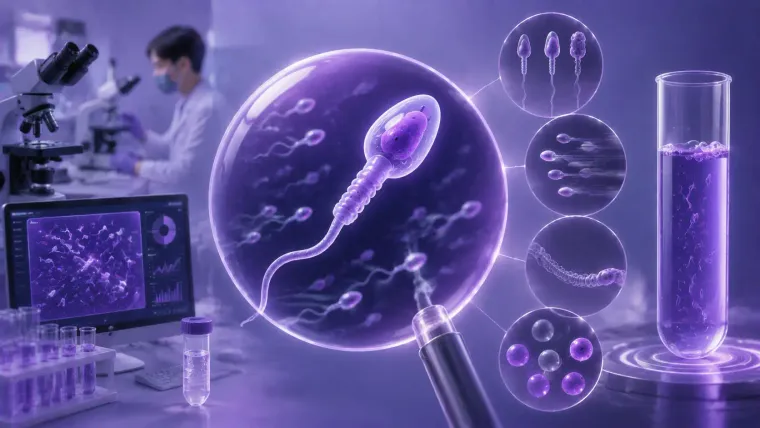
A sperm analysis (semenogram — a complete laboratory examination of a semen sample to assess sperm quality and quantity) is the most critical baseline test for evaluating male fertility. This test provides data on testicular production capacity, the function of accessory reproductive glands (supporting glands such as the seminal vesicles and prostate that produce fluid to carry and protect sperm), and the patency of the ejaculatory ducts.
Since 2021, the World Health Organization (WHO) has published the 6th edition of its laboratory manual, which brings several important parameter updates compared to the 5th edition in 2010. Understanding how to read this test result helps couples interpret their fertility status more objectively.
Key Parameter Guidelines Based on WHO 6th Edition (2021)
Sperm analysis results present two main evaluation categories: macroscopic evaluation (assessment of the physical appearance of semen fluid such as volume, color, and viscosity) and microscopic evaluation (analysis of sperm cells under a microscope, including count, motility, and morphology). Below is a comparison table of normal limits according to the latest WHO standards:
Evaluation Parameter
WHO 5th Edition Normal Limits (2010)
WHO 6th Edition Normal Limits (2021)
Semen Volume
1.5 mL
1.4 mL
Sperm Concentration
15 million cells/mL
15 million cells/mL
Total Sperm Count
39 million per ejaculate
39 million per ejaculate
Total Motility
40% actively moving
42% actively moving
Progressive Motility
32% moving straight forward
30% moving straight forward
Normal Morphology
4% perfectly shaped
4% perfectly shaped
Vitality (Live Cells)
58% live cells
54% live cells
How to Read and Interpret Key Parameters
1. Semen Volume
The volume of semen expelled during ejaculation normally ranges above 1.4 mL. If the volume is very low (less than 1.0 mL) accompanied by an acidic pH, this condition may indicate an obstruction in the ejaculatory duct (the short duct that connects the vas deferens to the urethra and carries semen fluid out during ejaculation) or a congenital anomaly in the form of CBAVD (Congenital Bilateral Absence of the Vas Deferens — the failure of the vas deferens ducts to form since birth on both sides).
2. Sperm Concentration and Total Count
The WHO 6th edition emphasizes the importance of calculating the total number of sperm in a single ejaculate (minimum 39 million cells), rather than just the concentration per milliliter. This is because a high semen volume can visually dilute the sperm concentration, even though the total number of sperm cells produced is actually sufficient.
3. Sperm Movement Classification (Motility)
Sperm movement is assessed because it is crucial for sperm to be able to swim through the cervix and uterus to reach the egg in the fallopian tube. In the 6th edition, sperm movement is divided into four categories:
- Rapid Progressive: Sperm swim actively straight forward at a high speed.
- Slow Progressive: Sperm swim forward but slowly or slightly curved.
- Non-progressive: Sperm only move in place without changing position.
- Immotile: Sperm remain completely motionless.
A man is considered to be within normal limits if the percentage of sperm with progressive movement (rapid + slow) reaches a minimum of 30%.
4. Sperm Shape (Morphology)
Normal sperm have a smooth oval-shaped head, a straight midpiece (neck), and a long single tail. Based on the Kruger criteria — a very strict and internationally used standard for assessing sperm morphology — a minimum of 4% of sperm must be perfectly shaped to be categorized as a fertile sample.
Medical Terms for Abnormal Sperm Analysis Results
- Oligozoospermia: Sperm concentration less than 15 million/mL — the sperm count is too low.
- Asthenozoospermia: Progressive movement percentage less than 30% — sperm are less actively moving.
- Teratozoospermia: Normal morphology percentage less than 4% — sperm shape is mostly abnormal.
- Oligoasthenoteratozoospermia (OAT): A combined abnormality where sperm count, movement, and shape are all below normal limits simultaneously.
- Azoospermia: No sperm cells are found at all in the ejaculated fluid after a centrifugation examination (spinning the sample at high speed to collect sperm that might be present in very small amounts).
Advanced Testing: Sperm DNA Fragmentation (SDF)
Sometimes a sperm analysis result looks normal, but couples still experience implantation failure (the process of the embryo attaching to the uterine wall as the beginning of pregnancy) or recurrent miscarriages. The WHO 6th edition now recommends an advanced test known as the Sperm DNA Fragmentation Index (DFI) — a test that assesses the quality of genetic material (DNA) inside the sperm head; sperm with damaged DNA can hinder fertilization or embryo development. DFI levels are divided into:
- DFI ≤ 15% (Low/Good): Sperm DNA integrity is excellent.
- 15% < DFI < 30% (Moderate): Can still fertilize, but the risk of failure is slightly increased.
- DFI ≥ 30% (High/Poor): Strongly correlated with reduced fertilization rates in conventional IVF, failure of embryo development to the blastocyst stage (embryo development stage around day 5 before it is ready to be implanted into the uterus), and an increased risk of early miscarriage.
References
• World Health Organization. (2021). WHO Laboratory Manual for the Examination and Processing of Human Semen, 6th Edition. Geneva: World Health Organization.
• Björndahl, L., & Kirkman-Brown, J. (2022). The Sixth Edition of the WHO Manual on Semen Examination: Ensuring Quality and Standardization in Basic Examination of Human Ejaculates. Fertility and Sterility.
• Schlegel, P. N., et al. (2021). Diagnosis and Treatment of Infertility in Men: AUA/ASRM Guideline. Journal of Urology.
Disclaimer: This information is for educational purposes and does not replace a doctor’s evaluation. Diagnostic and therapeutic decisions should be tailored to your and your partner’s examination results.