

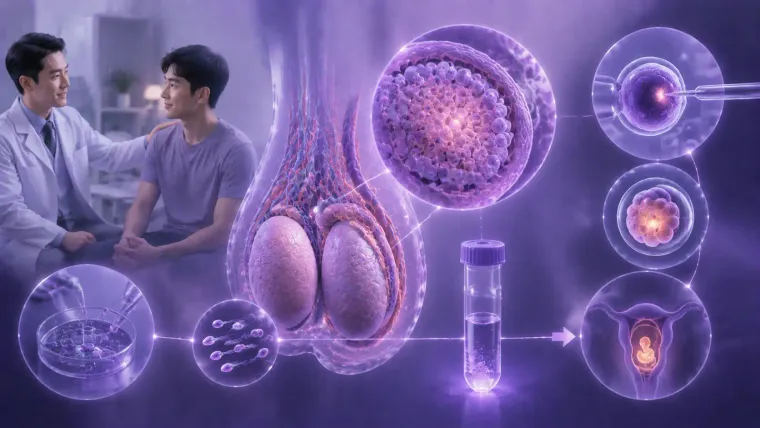
Azoospermia is a condition where no sperm is found in the ejaculate fluid, confirmed through centrifugation (spinning the sample at high speed to collect sperm that might be present in very small amounts) on at least two consecutive semen analyses. This condition is divided into two types: obstructive (there is a physical blockage in the reproductive tract, but the testicles still produce sperm) and NOA (Non-Obstructive Azoospermia — where the testicles indeed do not produce sperm normally). NOA accounts for about 60% of all azoospermia cases and has long been considered a difficult-to-treat cause of male infertility.
Why NOA is difficult to treat and how micro-TESE overcomes it
Men with NOA generally show signs such as high levels of FSH (Follicle Stimulating Hormone) and LH (Luteinizing Hormone) — this is the body’s response due to abnormally functioning testicles — as well as low testosterone levels and shrunken testicular size. In NOA, sperm production inside the testicles is uneven, but rather focal — meaning it is only present in certain small pockets scattered among inactive testicular tissue. This is why conventional random biopsies often fail to find sperm.
Microsurgical innovation through micro-TESE (Microdissection Testicular Sperm Extraction — sperm retrieval from the testicle using a high-magnification microscope), introduced in 1998, revolutionized the treatment of this condition. With 20–25 times magnification, doctors can examine the entire testicular tissue and identify tubules (small tubes inside the testicle where sperm is produced) that are still active based on their visual appearance — healthy tubules look wider, thicker, and opaque white, while inactive ones appear thin and transparent. This method minimizes tissue damage and preserves the hormonal function of the testicles after surgery.
How big is the chance of success for micro-TESE?
The success of micro-TESE is measured by the SRR (Sperm Retrieval Rate — the percentage of success in finding sperm that can be used for fertilization). The global average SRR for micro-TESE ranges between 30–63%, making it about 1.5 times more effective compared to conventional biopsy. In direct comparisons, micro-TESE achieves a 47% SRR compared to conventional random biopsy which is only 30%.
Several clinical factors influencing the chance of success:
First-time vs. repeat surgery. Patients undergoing micro-TESE for the first time have a much higher chance of success (64.6%) compared to those undergoing a repeat procedure (28.8%). Patients with repeat surgeries are generally older, have a higher smoking history, and a poorer hormonal profile.
Genetic factors. Men with NOA due to Klinefelter syndrome (a 47,XXY chromosome abnormality — where a man has an extra X chromosome) show an SRR of about 47% at experienced centers. Conversely, men with microdeletions of the AZFc region on the Y chromosome (a deletion of part of the Y chromosome that plays a role in sperm production) have the lowest chance of success.
The number of sperm found. If very few sperm are found (less than 20 cells), the cumulative live birth rate (cLBR — the percentage of pregnancies that successfully result in a live birth after all embryo transfer cycles) only reaches 28.1%. If more than 20 sperm cells are found, the cLBR increases significantly to 51.9%.
Hormone therapy before surgery and the use of frozen sperm
Some doctors recommend hormone therapy before surgery using Clomiphene Citrate (CC) — a medication that stimulates the body to produce more FSH and LH, which ultimately increases testosterone levels within the testicles. Although CC has been shown to increase testosterone levels in NOA patients, statistical analysis shows no significant increase in SRR between the group using CC (SRR 25.9%) compared to the group without hormonal therapy (SRR 31.0%).
Once sperm is successfully found, the sperm can be frozen for later use. Although sperm cells from NOA are vulnerable to damage during the freezing and thawing process, clinical data shows no significant difference in live birth rates between frozen sperm (47.5%) and fresh sperm (42.9%). The rate of congenital birth defects in babies resulting from this technique is also very low (1.43%), confirming its long-term safety.
Comparison of outcomes for first-time vs. repeat micro-TESE
Variable
First-Time
Repeat
Notes
Sperm Retrieval Rate (SRR)
~64.6%
~28.8%
Significantly different
Basal FSH hormone level
Median 14.0 IU/L
Median 18.0 IU/L
Significantly different
Basal LH hormone level
Median 12.0 IU/L
Median 19.0 IU/L
Significantly different
Total testosterone level
Median 3.0 ng/mL
Median 2.2 ng/mL
Significantly different
Smoking history
33%
59%
Significantly different
Klinefelter syndrome cases
~40%
~20%
Significantly different
Next Steps
If you are diagnosed with non-obstructive azoospermia, discuss with a reproductive urologist specialist regarding your eligibility to undergo the micro-TESE procedure as well as its preparation.
Free HagiaMed Consultation — a free initial consultation with our specialists, with no cost and no commitment.
References
• Predictors of sperm retrieval success in first-time and repeated micro-TESE for nonobstructive azoospermia. PMC.
• Does Clomiphene citrate administration increase the success rate of microdissection testicular sperm extraction in non-obstructive azoospermic men? PMC.
• Non-Obstructive Azoospermia and the Impact of micro-TESE. Irish Medical Journal.
• Clinical Outcomes and Live Birth Rate Resulted From Microdissection Testicular Sperm Extraction With ICSI-IVF in Non-Obstructive Azoospermia. Frontiers.
Disclaimer: This information is educational in nature and does not replace a doctor’s evaluation. Diagnostic and therapeutic decisions must be tailored to the examination results of you and your partner.