

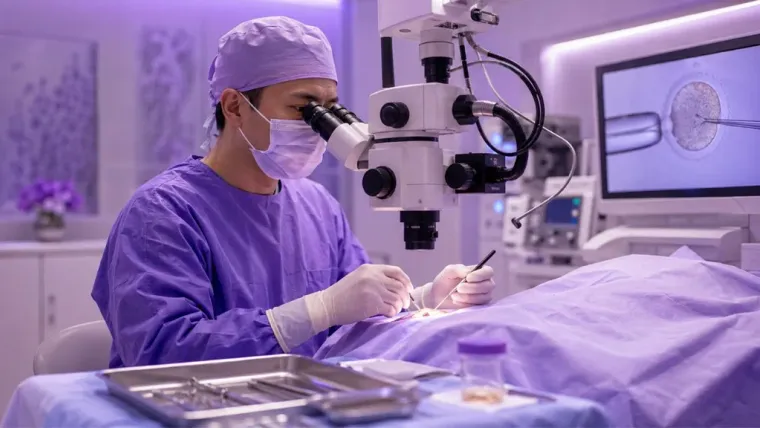
micro-TESE for azoospermia is a procedure to retrieve sperm from the testicles with the help of an operating microscope, and is usually discussed for men with non-obstructive azoospermia. In this condition, sperm may not appear in the ejaculate fluid, but in some patients, there are still small areas in the testicles that continue to produce sperm.
For couples who have already heard the phrase “no sperm,” micro-TESE is often a term that brings both hope and anxiety. Therefore, it is important to understand when this procedure is genuinely worth considering, and when it is better to pause for a more comprehensive evaluation first.
When micro-TESE for azoospermia is usually considered
micro-TESE for azoospermia is typically considered in men with NOA (Non-Obstructive Azoospermia — a condition where the testicles do not produce sperm normally) who are candidates for ART (Assisted Reproductive Technology — such as IVF and ICSI) programs. The American Urological Association (AUA) alongside the American Society for Reproductive Medicine (ASRM) directly recommends micro-TESE for men with NOA undergoing sperm retrieval, while the European Association of Urology (EAU) cites micro-TESE as the primary choice for retrieving sperm in NOA patients.
Before the procedure, the diagnosis of NOA should be well-confirmed. The EAU recommends confirmation on two consecutive semen analyses when no sperm is found after centrifugation, followed by evaluation of history, hormones, genetics, and scrotal ultrasound if necessary.
This means that micro-TESE is not an “immediate action” procedure as soon as the semen results come back empty. This procedure is most appropriate when the doctor is reasonably certain that the patient is indeed on the NOA pathway and that a retrieval attempt is still worth pursuing.
What doctors look for when performing micro-TESE for azoospermia
The concept of micro-TESE stems from the reality that in NOA, the process of sperm formation (spermatogenesis) can be focal — meaning not all testicular tissue is the same; there can be small areas that still contain sperm even though most of the tissue appears non-productive.
In the AUA/ASRM guidelines, micro-TESE in meta-analyses appears to yield a sperm retrieval success rate about 1.5 times higher compared to non-microsurgical testicular sperm extraction in certain populations. The EAU also notes that positive sperm retrieval is reported in up to around 50% of NOA patients across various studies, although there is no single predictor that can truly guarantee the result.
Therefore, the conversation before the procedure must be honest. micro-TESE is a rational and evidence-based effort in selected patients, but it is still not a guarantee that sperm will be found.
Risks and important considerations before micro-TESE for azoospermia
Every surgical procedure carries risks. The AUA/ASRM notes that although the effect on testosterone tends to be smaller compared to conventional TESE, a testosterone deficiency requiring replacement therapy can still occur after micro-TESE.
Genetic testing is highly important before the procedure in some patients. The EAU emphasizes that in the complete deletion of the AZFa and AZFb regions on the Y chromosome (complete AZFa and AZFb microdeletions) — a genetic condition where the genes responsible for sperm production are completely missing — the chance of finding sperm is zero, so a sperm retrieval procedure is not recommended. Genetic counseling is also mandatory if an abnormality is found that could potentially be inherited.
In other words, a good micro-TESE decision is not just about the courage to undergo the procedure, but also about the correct patient selection. That is why a complete initial examination actually protects couples from procedures that do not offer tangible benefits.
After micro-TESE, the pathway usually continues to ICSI
If sperm is successfully found, its use is most often directed to ICSI (Intracytoplasmic Sperm Injection — a procedure of injecting a single sperm directly into an egg). The AUA/ASRM states that in surgical sperm retrieval, either fresh or frozen sperm can be used for ICSI, depending on the clinical strategy and the quality of the available sample.
Momart IVF offers micro-TESE, IVF, and ICSI services. For couples weighing treatment abroad, the discussion can be directed all at once: are you a candidate for the procedure, how is the preparation of the female partner, and does the timing of the procedure need to be aligned with the IVF & ICSI cycle.
Ultimately, the success of the steps following micro-TESE does not depend on the procedure itself alone. The female partner’s condition, the quality of the embryology laboratory (the science studying embryo development in the laboratory), and the chosen IVF & ICSI strategy also play a determining role.
Conclusion
micro-TESE for azoospermia is most relevant in patients with non-obstructive azoospermia who have gone through a complete evaluation and still have sufficient medical reasons to undergo sperm retrieval. This procedure is supported by clinical guidelines, but it still needs to be understood as a measured effort, not a guaranteed outcome.
If you and your partner are at this stage, the most important questions are not just “do we need micro-TESE,” but rather “are we the right candidates, what are the realistic chances, and what are the next steps if sperm is found.” It is these questions that usually make the decision feel calmer.
Next Steps
If your doctor is already pointing towards NOA, previous medical documentation is very helpful to assess whether micro-TESE is indeed the most appropriate next step.
Free HagiaMed Consultation — a free initial consultation with our specialists, with no cost and no commitment.
References
• American Urological Association and American Society for Reproductive Medicine. Diagnosis and Treatment of Infertility in Men.
• European Association of Urology. Sexual and Reproductive Health Guidelines: Male Infertility.
• Corona G, et al. Sperm recovery and ICSI outcomes in men with non-obstructive azoospermia: a systematic review and meta-analysis. Human Reproduction Update.
Disclaimer: This information is educational in nature and does not replace a doctor’s evaluation. Diagnostic and therapeutic decisions must be tailored to the examination results of you and your partner.