

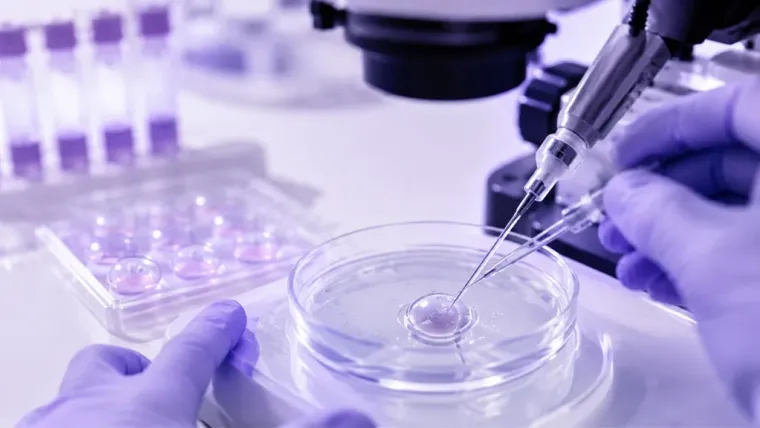
IVF & ICSI (Intracytoplasmic Sperm Injection — a procedure of injecting a single sperm directly into an egg) for azoospermia is usually the pathway discussed when sperm is unavailable in the ejaculate fluid, but can still be obtained through a sperm retrieval procedure (retrieving sperm directly from the epididymis or testicles via surgery) or found through further evaluation. In many azoospermia cases, ICSI is the most relevant choice because the number of available sperm is very limited and needs to be used in a highly targeted manner.
For couples, this stage often feels like entering a completely new world. Therefore, it is important to understand that IVF & ICSI are not two terms used randomly, but are part of a process structured based on the cause of male infertility and the readiness of the female partner.
When IVF & ICSI for azoospermia becomes a realistic choice
IVF & ICSI for azoospermia makes the most sense when sperm can be retrieved from the epididymis or testicles, or when a doctor assesses that the chances of natural conception are unrealistic. The American Urological Association (AUA) alongside the American Society for Reproductive Medicine (ASRM) explicitly discusses that in men with azoospermia due to obstruction, sperm can be extracted from the testicle or epididymis, and then used in ICSI.
In NOA (Non-Obstructive Azoospermia — a condition where the testicles do not produce sperm normally), this pathway is usually only discussed after the patient is deemed suitable for sperm retrieval, including micro-TESE in selected patients. The European Association of Urology (EAU) states that sperm retrieval procedures in NOA essentially become part of the ART protocol (Assisted Reproductive Technology — such as IVF and ICSI), including IVF cycles through ICSI.
This means that the decision for IVF & ICSI is not just about “wanting to get pregnant quickly,” but about whether medically this is the pathway that best fits the existing data.
IVF & ICSI for azoospermia starts with the preparation of both partners
Before starting IVF, both the man and the woman undergo a series of evaluations. Ovarian reserve, uterine condition, infections, and sperm quality are assessed before the action strategy is established.
This aligns with the AUA/ASRM, which emphasizes that the evaluation of the male and female partners should run in parallel, and that the female partner’s age is a very strong predictor of fertility outcomes. Therefore, discussing IVF & ICSI for azoospermia without looking at the female partner’s reproductive condition would make the plan incomplete.
In practice, couples will usually discuss the timing of ovarian stimulation, when the sperm retrieval is performed, whether the sperm will be frozen (cryopreservation — the process of storing sperm at very low temperatures for future use), and what the realistic chances are based on both partners’ factors. An honest conversation at this stage actually makes the process feel more organized.
How the IVF & ICSI process for azoospermia unfolds
Broadly speaking, IVF involves ovarian stimulation, egg (oocyte) retrieval, sperm retrieval or preparation, fertilization in the laboratory, and embryo transfer. The stages include ovarian stimulation, oocyte retrieval, sperm retrieval, and embryo implantation.
The role of ICSI here is to inject a single sperm into a single egg. In cases of azoospermia, this technique is very important because the available sperm is often scarce, obtained through surgery, or its motility is not sufficient to rely on conventional fertilization.
The AUA/ASRM also states that in surgical sperm retrieval, either fresh or frozen (cryopreserved) sperm can be used for ICSI. This provides flexibility for the fertility center to devise the safest and most efficient strategy for the couple.
Factors influencing the results of IVF & ICSI for azoospermia
The most important thing to honestly convey is that the success of IVF & ICSI for azoospermia is not determined by a single factor alone. The availability of sperm, the quality of the embryology laboratory (the science studying embryo development in the laboratory), ovarian response, oocyte quality, the female partner’s age, and embryo quality all play a role.
In couples with NOA, the first challenge is finding the sperm. If sperm is successfully obtained, the focus shifts to fertilization, embryo formation, and the chance of pregnancy. That is why hope remains, but it must be conveyed as an opportunity influenced by many variables, not a straight line that is the same for everyone.
Momart IVF offers IVF, ICSI, and micro-TESE services, including support for patients from abroad — making it a viable option to consider for couples who are already at this stage.
Conclusion
IVF & ICSI for azoospermia is generally the most relevant pathway when sperm needs to be retrieved directly from the epididymis or testicles, or when the chance of natural pregnancy is deemed very small. The process involves both parties, not just the man, so the couple’s evaluation must be seen as a whole.
If you are considering IVF & ICSI for azoospermia, the main focus should be on the completeness of the diagnosis, the readiness of the female partner, and understanding the process entirely. By doing so, the decisions made will feel calmer, more rational, and more suited to the real conditions of you both.
Next Steps
If your discussions with your partner are already pointing towards sperm retrieval or IVF & ICSI, a structured consultation will be very helpful to see if the timing and steps are correct.
Free HagiaMed Consultation — a free initial consultation with our specialists, with no cost and no commitment.
References
• American Urological Association and American Society for Reproductive Medicine. Diagnosis and Treatment of Infertility in Men.
• Momart IVF. Services and IVF Treatment.
• European Association of Urology. Sexual and Reproductive Health Guidelines: Male Infertility.
Disclaimer: This information is educational in nature and does not replace a doctor’s evaluation. Diagnostic and therapeutic decisions must be tailored to the examination results of you and your partner.